

How Smart Vending Machines Help Reduce Operational Costs

For CFOs, vending is not just “amenities spend” it’s a distributed, always-on micro-retail network. Smart vending compresses costs across payments, inventory, logistics, energy, and reconciliation while improving auditability. Below is a practical cost framework you can plug into your model, plus the specific controls Vendekin enables to turn vending into a lean P&L line.
The Cost Stack (and where savings hide)
Payments & Cash Handling
Remove float, counting time, variances, and CIT fees with UPI (PhonePe/GPay) and RFID staff wallets.
Higher payment success → fewer abandoned baskets → lower refund overhead.
Inventory & Shrink
Real-time stock + planogram prevent over-stocking and expiry write-offs.
Elevator (Elevend) dispensing reduces breakage for beverages.
Logistics & Truck Rolls
OOS risk alerts and route clustering cut wasted trips and MTTR.
First-time-fix improves when tickets originate from telemetry, not end-user complaints.
Energy & Temperature Control
Multi-zone set-points, door-seal alerts, and condenser hygiene reminders reduce kWh/Mo.
Temperature telemetry avoids spoilage (silent margin killer in chilled/frozen).
Finance & Reconciliation
Unified settlements (UPI/RFID) + EOD exports save hours of manual matching.
Maker–checker and audit logs lower compliance risk and rework.
Where the Savings Come From (with conservative ranges)
Cash handling & payment ops: 2–5% OpEx reduction (no cash variance, faster close).
Expiry/breakage/shrink: 15–40% less loss where planograms and elevator are used correctly.
Route efficiency & service calls: 10–25% fewer trips via OOS clustering and predictive alerts.
Energy optimization: 5–12% kWh reduction from set-point discipline + coil/condenser care.
Back-office time: 30–60% time saved on reconciliation, status checks, and manual reporting.
Your exact lift depends on category mix, climate, refilling discipline, and baseline payment success.
The Vendekin Cost-Control Stack
1) Cashless that “just works”
UPI dynamic QR (PhonePe/GPay) + RFID staff wallets (subsidies/time windows) minimize failures and speed queues.
Cleaner EOD: settlements, refunds/voids, and tax exports in one place.
2) vNetra: real-time telemetry → fewer surprises
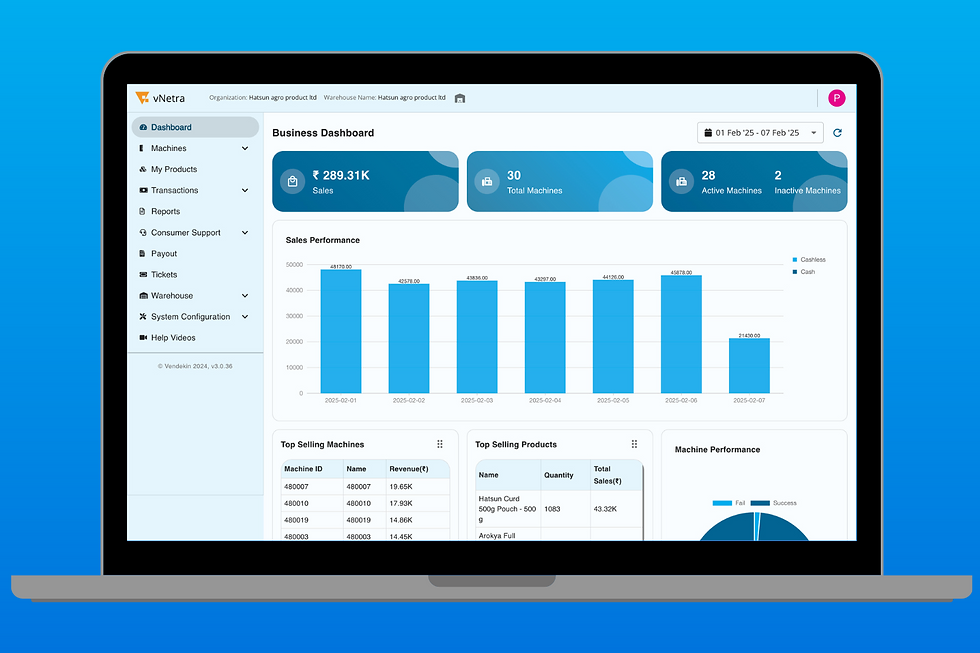
Online/offline, temps, error codes, door events issues surface before they become revenue leaks.
Planogram intelligence: push facings for winners, retire dead slots; track expiry risk.
Promos at scale: time-bound discounts and combos to shape demand without site visits.
OTA: prices, content, and firmware rolled out fleet-wide in minutes.
3) Hardware that protects gross margin
Elevator (Elevend) dispensing for fragile/heavy items → lower breakage & complaints.
Multi-zone cooling with live set-points + alerts → stable quality, less spoilage.
Multi-vend cart → higher AOV per session (revenue effect with the same Opex base).
Quick Model: What a Lean Site Looks Like
90 tx/day × ₹55 ASP × 22 days = ₹1,08,900 revenue/month
COGS @ 68% = ₹74,052
Legacy Opex (pre-smart): logistics ₹9,500 + energy ₹4,000 + refunds/variance ₹1,800 + admin/recon ₹3,000 = ₹18,300
Net (legacy) ≈ ₹16,548/month
After smart vending (vNetra + UPI/RFID + elevator + set-point SOP):
Logistics −15% → ₹8,075
Energy −8% → ₹3,680
Refunds/variance −50% → ₹900
Admin/recon −40% → ₹1,800
New Opex ≈ ₹14,455 → Net ≈ ₹20,393/month (≈ +23% net lift)
Same revenue, lower waste your payback shortens without pushing more volume.
CFO Checklist: Controls to Ask For (and log)
Payment success ≥ 98.5% (UPI/RFID), daily automated EOD.
OOS hours < 2% of trading time (alert routing to service).
Expiry write-off < 0.8% of sales (FIFO + planogram).
Energy per cabinet (kWh/mo) and variance week-over-week.
MTTR on incidents + % first-time-fix via telemetry-originated tickets.
Audit trail: maker–checker for price/content/firmware changes.
Risk & Compliance Notes (India)
Food safety: temperature logs exportable for inspections (FSSAI).
Payments: UPI/RFID reports + refund logs aid statutory audits.
IT security: signed firmware, encrypted storage, staged OTAs with rollback lower operational risk.
Conclusion & Next Steps
Vending machine cost saving is a compounding effect: cashless rails reduce friction, telemetry prevents losses, and cloud workflows remove manual grind. Vendekin’s hardware plus vNetra gives CFOs line-of-sight to every rupee of OpEx so you can scale what works and cut what doesn’t.


Comments