

What’s Trending in the Vending Industry? 4 Notable Advancements in 2026

The vending industry is rewriting how businesses think about distribution, access, and customer experience. What started as a simple snack-and-drink model has evolved into one of the fastest-growing forms of unattended retail. Across India, the Middle East, Europe, and the US, we now see entrepreneurs and brands treating vending not as a side channel, but as a high-yield, data-driven micro-retail ecosystem.
Inside this shift, four major vending industry trends are reshaping how products reach consumers and how operators grow. And at the center of these changes, companies like vendekin and its smart software vNetra are enabling a new level of control, visibility, and ROI.
Let’s break down the four trends transforming the vending landscape.
1. Smart Vending Is Becoming the Default, Not the Upgrade
For years, vending machines lagged behind modern retail tech. That is no longer true. The industry is witnessing a mass shift from traditional coin-based machines to smart, cashless, connected systems.
What’s driving this shift?
Large-scale adoption of UPI, card payments, and QR payments
Users expecting cashless, frictionless buying
Operators demanding remote visibility instead of manual checks
Brands asking for consistent retail presence without staffing
Smart vending is now the baseline expectation. Machines with SIM/Wi-Fi connectivity, multi-vend, digital UI, and instant refunds outperform older systems across locations.
Inside this transition, vNetra, vendekin’s vending management platform, gives operators live tracking of stockouts, machine uptime, sales behavior, and refill needs. This single change is reducing unnecessary travel, improving machine uptime, and increasing monthly revenue.
The trend is clear, smart vending is no longer optional, it's the new operating system of unattended retail.
2. Tier 2 Cities Are Adopting Vending Faster Than Tier 1
One of the surprising vending industry trends is the hyper-growth outside metros. Tier 2 and Tier 3 markets are scaling smart vending faster than expected, and the reasons are structural.
Why Tier 2 demand is booming:
UPI saturation arrived before organized retail, making users digitally comfortable
Fewer 24/7 retail outlets create natural demand for unattended formats
Colleges, hospitals, hostels, and workplaces prefer vending to reduce dependency on canteens
Local brands want cost-effective distribution without investing in stores
In these markets, smart vending is often the first modern retail touchpoint, which makes adoption even stronger.
Entrepreneurs in Tier 2 cities are also using vendekin-enabled machines to start low-risk, high-return vending businesses with faster payback periods. For CEOs, the message is clear, the next wave of unattended retail growth won’t come from metros alone.
3. Product Categories Are Evolving Beyond F&B
Earlier, vending machines were synonymous with chips, chocolates, and beverages. Today’s demand looks very different.
New-age vending categories gaining traction:
Ice cream and frozen desserts (fastest-scaling category in India)
Hot food for office corridors and co-working spaces
Personal care & hygiene essentials
Electronics & mobile accessories
Wellness & health products
D2C brand sampling and micro-stores
Businesses are using vending as a way to:
Launch new SKUs
Test product-market fit
Enter gated communities
Increase brand visibility
Reduce distribution cost
Smart vending is functioning as a micro-retail expansion strategy.
With solutions like vendekin’s Omnivend, Elevend, and Advend range, entrepreneurs and brands can customize formats, temperatures, and capacities for use cases that were traditionally impossible in vending.
The trend is simple, vending is now a store, not a machine.
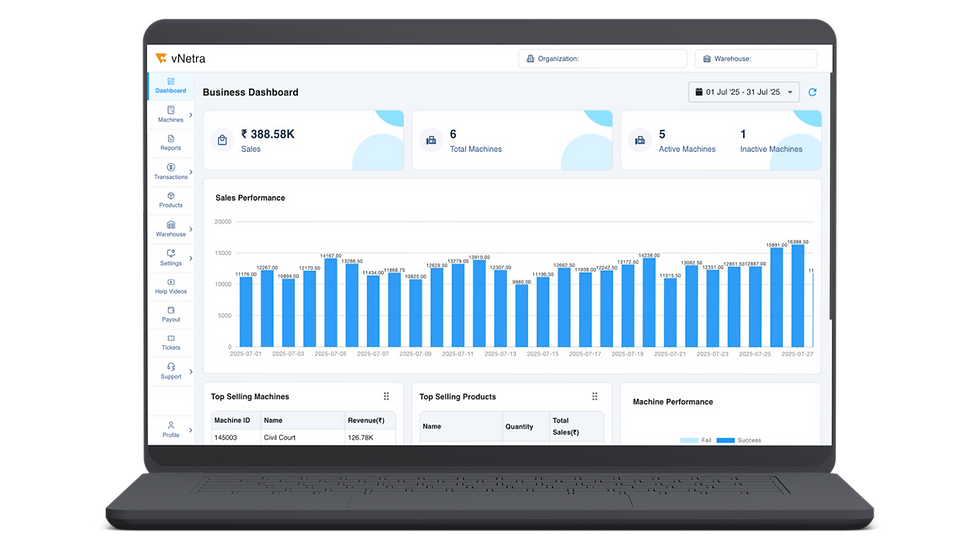
4. Operators Are Running Data-Driven Businesses, Not Guesswork Operations
Earlier, the vending business depended on:
Physical visits
Manual inventory checks
Trial-and-error product stocking
Cash collections
Reactive maintenance
This approach limits scale, speed, and profitability.
Modern operators are now running data-led vending companies.
Key transformations:
Machines share real-time stockouts, temperature, and sales trends
Operators optimize product mix based on high-selling time slots
Predictive restocking reduces empty columns
Instant refund systems improve customer trust and repeat use
Planograms show which machines deserve expansion
This shift is largely powered by advanced vending management systems like vNetra, which centralizes every machine in a clean dashboard.
For CEOs and entrepreneurs, it means vending is now a transparent, controllable, scalable business rather than a field-heavy operational challenge.
What These Trends Mean for Businesses
If you’re exploring vending either as a distribution channel or as a new business line, these vending industry trends reveal a clear direction.
Demand is shifting to smart, cashless experiences
Growth is accelerating fastest in Tier 2 markets
New product categories are expanding the total addressable market
Data is becoming the engine that drives profitability
And with platforms like vendekin + vNetra (Ecosystem) simplifying everything from machine selection to deployment, analytics, refunds, and uptime, entrepreneurs can scale vending businesses with confidence.
Conclusion
The vending industry is entering a high-growth phase driven by technology, digital payments, new customer behavior, and smarter operations. For entrepreneurs and CEOs, this is the right time to look at vending not just as a convenient retail model, but as a strategic, revenue-driven distribution channel.
With vendekin’s smart vending machines and vNetra’s remote management platform, businesses gain the advantage of automation, data insights, and seamless customer experiences that define the future of unattended retail.
The question is no longer “Is vending relevant?” The real question is “How fast can you adopt it?”


Comments