

5 Ways in Which Mobile-Based Cashless Payments Can Transform the Vending Industry.

Long working hours, shift-based workplaces, and always-on consumption habits have increased demand for quick access to snacks, beverages, and ready-to-eat food. At the same time, manual food counters and catering models struggle with rising labour costs and limited operating hours. This gap is where mobile-based cashless vending machines are emerging as a scalable and cost-efficient solution for vending operators and businesses.
Mobile payments are no longer just a convenience feature. When combined with connected vending systems, they fundamentally change how vending machines operate, scale, and deliver value.
1. Improved Consumer Convenience
Convenience is the primary reason consumers gravitate toward cashless vending. Users no longer need to carry cash, search for exact change, or worry about failed card swipes. A mobile-based cashless vending machine allows them to complete a purchase in seconds using their phones.
In office environments, this convenience becomes especially important. Employees expect food and beverage access during late hours, night shifts, or between meetings. Cashless vending ensures availability without dependency on staff or manual counters.
For employers and facility managers, fewer payment-related issues mean fewer complaints and smoother operations. From a user perspective, vending becomes effortless. From an operator perspective, usage frequency improves.
2. Faster and More Reliable Transactions
Vending purchases are often impulse driven. A delay of even a few seconds can result in an abandoned purchase. Traditional cash handling and card readers slow down the transaction flow, especially during peak hours.
Mobile-based payments remove these friction points. Users do not need to insert coins, wait for refunds, or attempt multiple swipes. QR-based or app-enabled payments are faster, more reliable, and intuitive.
In high-footfall locations such as corporate offices, hospitals, colleges, and transit areas, faster transactions directly impact sales volume. Higher throughput during peak periods leads to increased vending machine revenue without changing machine placement or product pricing.
3. Enhanced Security and Reduced Operational Risk
Security remains one of the biggest challenges in traditional vending operations. Cash-heavy machines are vulnerable to theft, pilferage, and reconciliation errors. Operators also face risk while collecting and transporting cash from machines to offices or banks.
Mobile-based cashless vending significantly reduces this exposure.
Minimal or no cash stored in the machine
Lower risk of theft and vandalism
Transparent digital transaction records
For consumers, mobile payments are also safer. Cashless transactions eliminate the need to swipe cards or interact with exposed hardware, reducing the risk of data theft or card skimming.
By reducing cash dependency, operators not only improve security but also simplify accounting and compliance.
4. Better Sales Visibility and Inventory Planning with vNetra
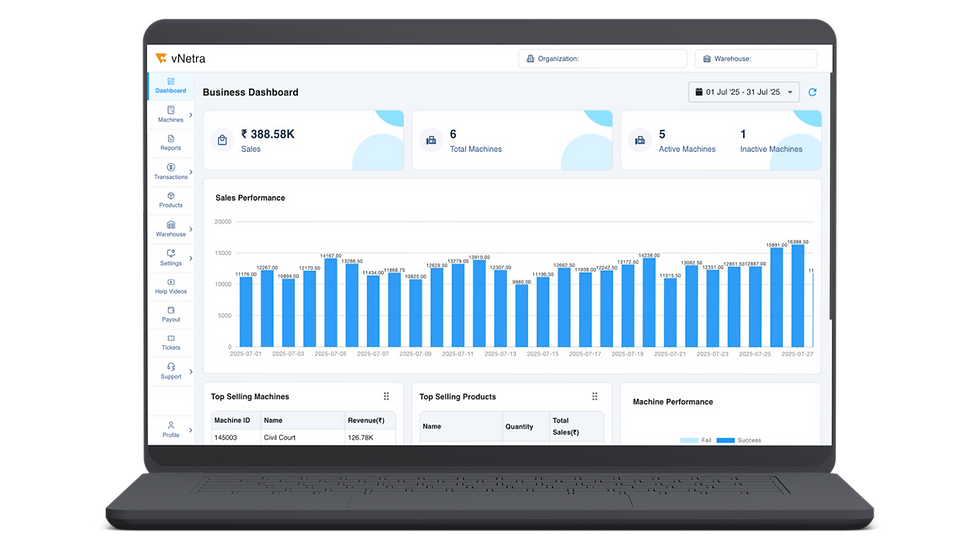
This is where mobile-based cashless payments truly transform vending operations.
When payments are connected to a backend system like vNetra, vending machines stop being standalone units and become data-generating retail points. Every transaction provides insight into consumer behaviour and machine performance.
With vNetra, operators can understand:
Which products sell best at each location
Time-based demand patterns, such as late-night or shift usage
Refill requirements to avoid stockouts
Underperforming machines or locations
Instead of relying on manual checks or assumptions, operators can plan inventory based on actual usage data. This reduces overstocking, prevents missed sales, and improves overall vending machine ROI.
Data-driven inventory planning also helps operators optimize fleet movement, saving fuel, time, and manpower.
5. Better Consumer Experience and Higher Retention
Many vending purchases are lost simply because users do not have cash or face payment failures. This is especially common during night shifts or in locations with limited nearby alternatives.
Mobile-based cashless payments remove this barrier completely. Consumers can pay instantly, making impulse purchases easier and more frequent.
Cashless vending also enables additional engagement layers. Operators can support loyalty programs, digital offers, or corporate benefits such as food allowances and internal wallets. These features encourage repeat usage and help build predictable consumption patterns at workplace locations.
Over time, this improves consumer retention and strengthens the vending machine’s role as a dependable retail point.
Why Mobile-Based Cashless Vending Is Easier to Scale
Scaling vending operations traditionally requires more machines, more cash handling, and more manual oversight. Cashless vending simplifies this process.
No cash logistics
Centralized visibility through software
Standardized payment experience across locations
When paired with vNetra, operators can manage multiple machines and sites from a single dashboard. This makes expansion into new offices, campuses, or cities far more manageable without proportionally increasing operational complexity.
Vending at Your Fingertips
Mobile-based cashless payments align vending with how consumers already pay in their daily lives. For operators, the shift delivers transparency, efficiency, and control. For consumers, it delivers speed and ease.
When combined with vNetra’s vending machine software, cashless vending moves beyond transactions into intelligent operations, enabling better decisions, lower risk, and higher profitability.
Conclusion
Mobile-based cashless payments are reshaping the vending industry by improving convenience, speed, security, and operational visibility. For vending machine operators, the biggest advantage is control, less cash complexity, better insights, and stronger ROI. With platforms like vNetra supporting analytics and monitoring, cashless vending becomes a future-ready model for offices, campuses, and high-footfall locations.


Comments